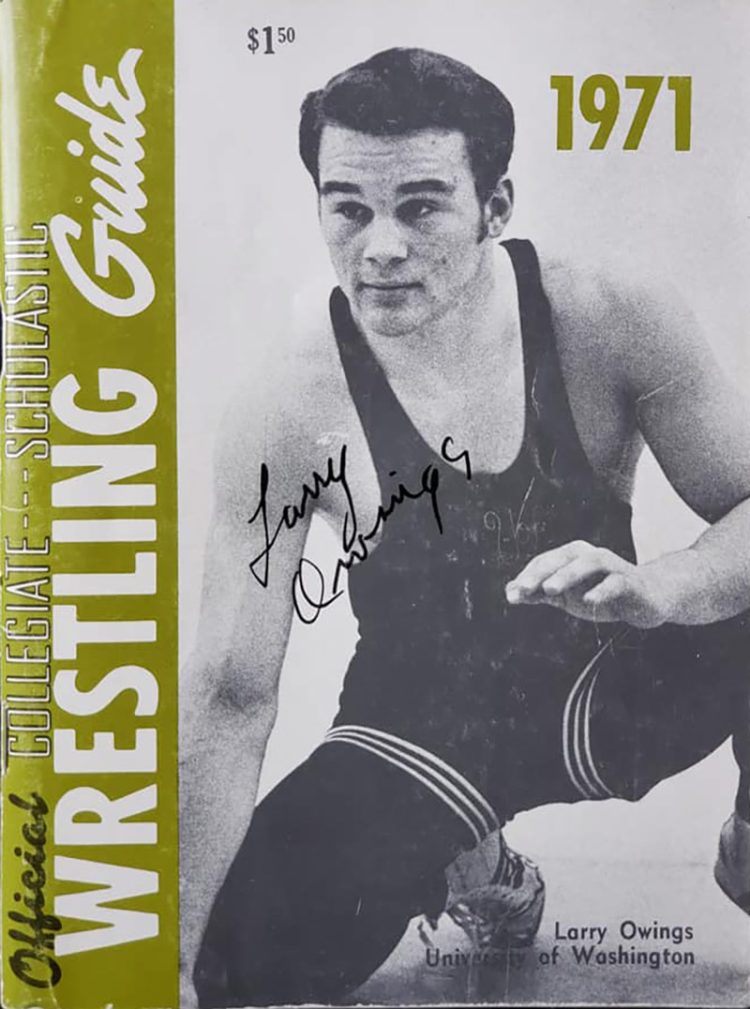
When Larry Owings was growing up in rural Oregon, everyone—his friends, his family, even his teachers—called him by the nickname “Porky.” They did this because he was overweight.
“Nowadays, they would call that bullying,” says Owings, now 75. “Back then, you just had to grin and take it. I can’t tell you how deep down inside I was hurting. It inspired me to say, ‘I’m gonna show you someday.’ “
Would he ever.
Owings had four older brothers, all of them state wrestling champs at Canby High School. Taking a gander at their baby brother in junior high, none of them expected Larry to wrestle at all, much less earn any kind of hardware. But a life-changing event—or occupation, rather—occurred in the summer before his freshman year.
“I went to work for an old Norwegian dairy farmer,” he recalls. “I hauled hundred-pound bales of hay for him all summer long. Before that, I worked on the farm picking berries, and I hated picking berries. There was no way I was not gonna do good in this job and go back to picking berries.”
Owings’ weight went from about 150 to 130 through the course of his sweaty vocation, and he also grew a couple of inches. In spite of his siblings’ doubts, he joined the Canby wrestling team and worked his way up to varsity at 123 pounds by the end of his freshman year. By the end of his high school career, he would win state championships in both the 136- and 141-pound weight divisions.
During his senior year, Owings was matched in a tournament with an Iowa State University sophomore named Dan Gable, who was undefeated and already an NCAA champion. Gable won their match rather easily, but Owings managed to score some points – quite a feat for anyone facing a man who would go down as the greatest amateur wrestler of all time.
After losing to Gable, Owings said he felt like he “had a score to settle.” Two years later, he’d get his chance.
Triumph, then turmoil
There were a lot of colleges interested in Owings’ wrestling services after high school, but the University of Washington won out.
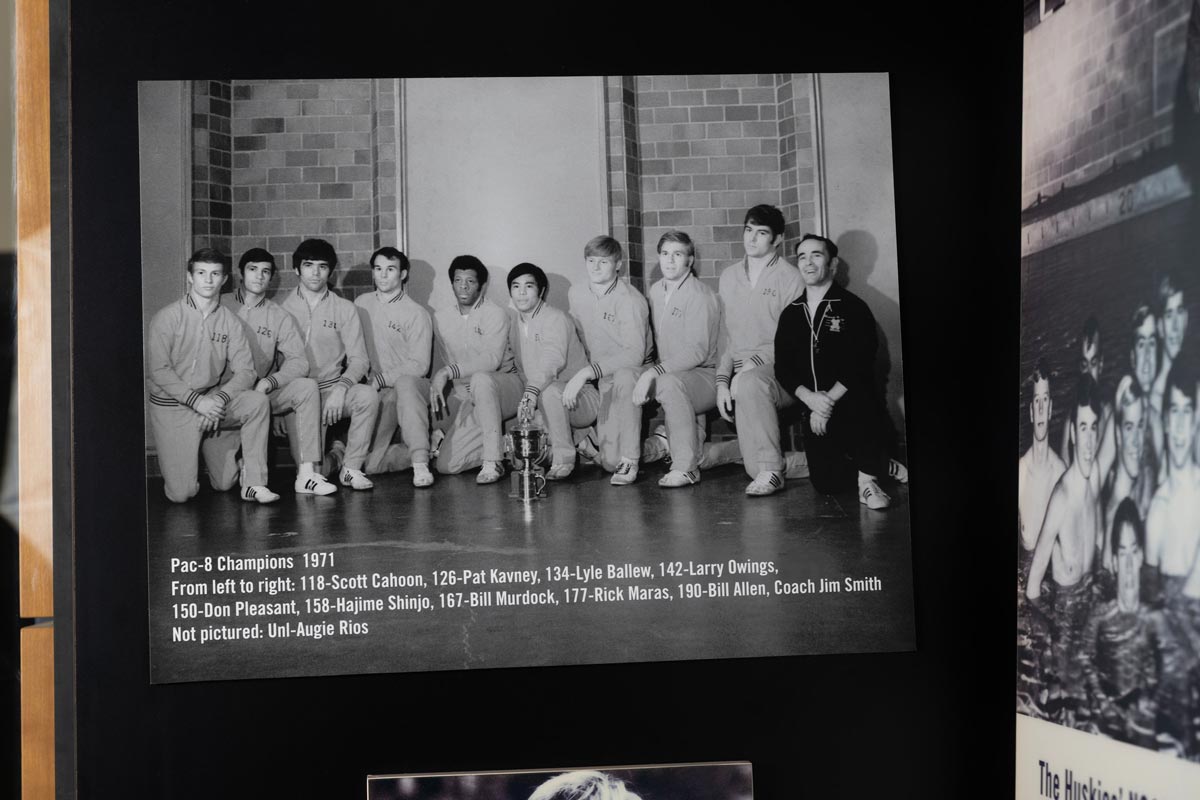
“I didn’t go to Oregon State because my brothers had gone there,” he explains. “I went up to the U-Dub, beautiful campus, coach was very gung-ho. Jim Smith – he’s still alive, by the way. He’s 90 and lives in Lynnwood. I liked the school, I liked the coach. I wanted to go into architecture, and they had a great architecture program.”
Owings, ’72, ’75, ’78, pursued an architecture degree for a quarter before he deemed it too difficult and switched to industrial education. Things on the mat went according to plan, however. By the time Owings was a sophomore, he was Pac-8 champion at 158 pounds with the 1970 NCAA tournament on the horizon.
But instead of competing in that weight class, Owings quickly shed 16 pounds so he could face Gable.
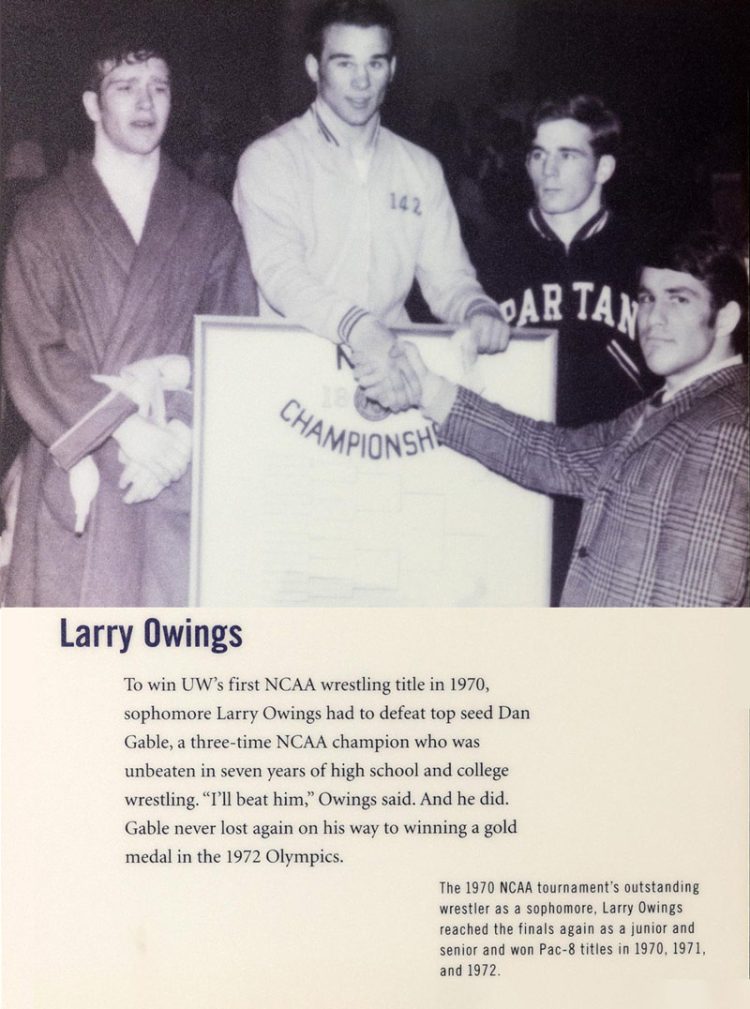
At the time, Gable boasted a record of 117-0. Counting high school, that mark stood at an unthinkable 181-0. Everyone viewed the tournament, which was held near Chicago on the Northwestern University campus, as Gable’s surefire coronation – everyone, that is, except for Owings, who told anyone who would listen that he thought he could beat the champ.
“I thought I had a little edge because whenever he wrestled anybody, he always pinned them,” says Owings. “He rarely had a full match. I thought, ‘I can push him,’ so my strategy going into that match was I was going to push him until he was exhausted. And that’s what happened in the third round. A lot of people didn’t know that I had wrestled him previously.”
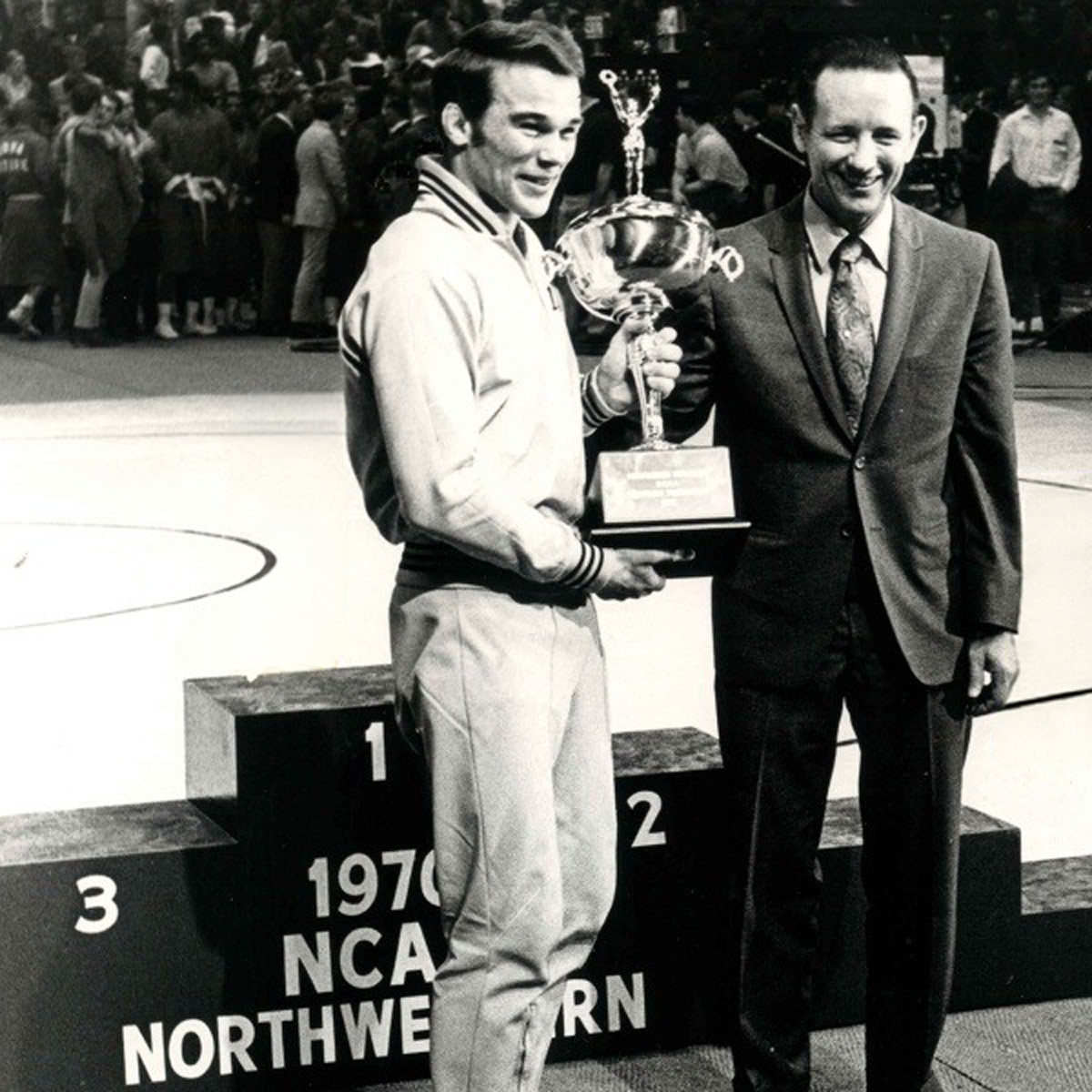
Owings and Gable met in the NCAA finals. Owings got out to a shocking 7-2 lead and led 8-4 before Gable finally took a 10-9 lead in the third and final round when riding time – points awarded for a disparity in control over the match – was taken into account. But Gable was visibly tired and, having won the vast majority of his matches by takedown, got greedy in the final seconds.
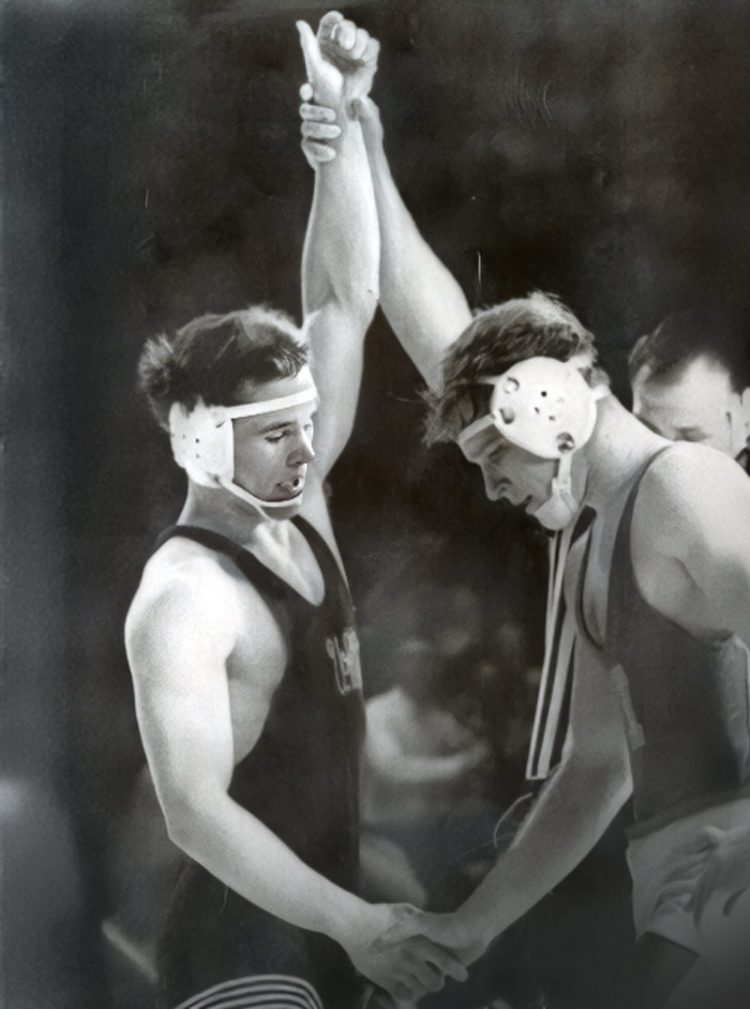
Owings capitalized, dropping Gable to the mat via a devastating leg sweep and exposing his shoulders to earn four additional points. The 13-11 margin would hold. Owings had scored the biggest upset in wrestling, if not all of individual sports, of all time.
Larry Owings receives the NCAA championship trophy from legendary wrestling coach Grady Peninger after defeating Don Gable in front of a 9,000-person sold-out crowd on Northwestern University’s campus in Evanston, IL.
The years ahead were kind to Gable, who would go on to win the 1972 Olympics without yielding a single point and then become the greatest collegiate coach of all time at the University of Iowa. As for Owings, he got married during his junior year. While this proved somewhat detrimental to his wrestling career and the marriage ultimately unraveled, he was NCAA runner-up in his junior and senior years and finished with a career record of 87-4.
That record doesn’t include the third and final time Owings wrestled Gable at the 1972 Olympic Trials, where Gable would go on to avenge his 1970 loss in convincing fashion.
“When I beat Dan Gable, I went from a nobody to a celebrity,” Owings recalls. “It was something I wasn’t accustomed to and something I didn’t necessarily relish. I became the top dog, and everybody was shooting for me. I didn’t like that. I’m much more introverted. I like to be the quiet guy that comes in and slips up on somebody.
“I was tired of the monkey being on my back and thought, ‘I’ll just go out and wrestle Dan Gable, he’ll beat me, and everybody will leave me alone.’ All of that happened, but people didn’t leave me alone.”
“My attitude was the problem all along. Once I changed that and embraced what had happened, I felt better myself and helped a lot of people.”
Larry Owings
The Hall beckons
Owings plied his craft quietly in the Pacific Northwest as an educator, including stints as a shop teacher and head wrestling coach at West Seattle’s Chief Sealth High School, until 2003. Since remarried, he moved back to near his boyhood home in Oregon and began to experience a change of heart about the 33-year-old accomplishment that defined him in the eyes of many.
“I just thought to myself, ‘This is never gonna go away. God gave me this talent of wrestling and here I am trying to run away from it and hide. We’re gonna stop doing that, we’re gonna embrace it and start sharing with other kids,” Owings says. “My attitude was the problem all along. Once I changed that and embraced what had happened, I felt better myself and helped a lot of people.”
Owings kept working with young wrestlers, something he does to this day. He still dons the headgear and gets on the mat to show them proper technique, something he hopes to do until he’s 80.
Considering he wrestled in the most famous match in NCAA history and spent the rest of his collegiate career proving it was no fluke, it might come as a surprise that Owings has yet to be inducted into the National Wrestling Hall of Fame in Stillwater, Oklahoma. The fact that UW shuttered its program in the 1980s – it’s since been resurrected as a club sport – hasn’t helped his cause, nor has the humble lifestyle he has chosen to live in an out-of-the-way corner of the country.
But Owings, who says he’s stayed friendly, if not chummy, with Gable over the years, has many staunch advocates, and a movement is now afoot to get the man the recognition he’s presumably due.
“He’s a legend,” says Hall of Famer Randall Tomaras, who grew up in Bellingham and has penned a letter of support on Owings’ behalf. “A lot of the people only remember that one match. They say he was a one-time wonder. No, he wasn’t. He was in the NCAA Finals three times.”
“He gave American wrestling its greatest story,” wrote Jim Kalin in one of his columns for Amateur Wrestling News. “Ask 100 wrestling fans who Larry Owings is, and all know. Not so with plenty of National Wrestling Hall of Fame Distinguished Members, many who have never won an Olympic gold medal or NCAA title. No wrestler has matched Owings’ single moment and season. Isn’t that alone worthy of his induction into the Hall of Fame?”
Owings believes it is.
“I probably belong in the Hall of Fame,” Owings says. “There are several people in the Hall of Fame that I’ve beaten. To me, that’s gonna be probably the greatest honor you can achieve in United States wrestling. Waiting this long, it might mean more to me.”
What happens if you let teens craft the rules that dictate their use of phones at school? You get policy ideas with a nuanced, holistic perspective that rival those being officially issued by the adults in leadership.
The University of Washington’s Youth Advisory Board, a group of approximately 20 teens from Seattle-area schools, recently published its first memo tackling this contentious issue. The memo weighs the pros and cons of phone bans and offers recommendations on how schools should draft and communicate their policies.
“The whole point of the memo was to bring teen experiences into real policy conversations,” said Jaden Hong, a sophomore at Eastlake High School and board participant. “I think it matters that our ideas get into the hands of the principals, district leaders and even state-level decision makers or legislators who are actively shaping phone and tech rules.”
The Youth Advisory Board’s memo was informed by a UW study and questionnaires on the impacts of phone rules at middle and high schools in Washington. The regulations ranged from all-day bans to restrictions during lunch and passing periods. The board’s key suggestions for high school policies include:
Compromise: Preferred policies allow phone use during breaks between classes and lunch, but not during academic time, as opposed to all-day bans.
Reframing: Use neutral language around the policy, avoiding polarizing terms like “ban” or “phone free.”
Inclusion/communication: Input is needed from students, parents and teachers, and should include polls and classroom discussions to get buy-in. Clearly communicate the policies.
Consistency: Make the rules school-wide and don’t vary them by teacher or class.
Diverse needs: Students with responsibilities outside of school (like some jobs) or with medical needs require leniency.
Social engagement: Educators need to foster social engagement during class lessons as well as structured social activities outside of academics.
Digital wellness: Beyond tech literacy, teens welcome classes on digital wellness and the healthy use of devices.
What the research showed
Lucía Magis-Weinberg, a developmental psychologist and head of the International Adolescent Connection and Technology Laboratory at the UW, conducted the surveys that helped inform the students’ opinions. Roughly 4,400 students, teachers and parents responded to the initial inquiry.
In the answers to questionnaires, teachers emphasized that with limited phone access, there are fewer distractions in the classroom, more social engagement and less bullying. Teens said the restrictions reduced the amount of cheating.
On the downside, teens and parents were concerned that communications were more difficult, such as friends making plans, scheduling with family, or in the case of an emergency. Teens and teachers noted that phones had positive instructional uses and could aid students with specific academic or language challenges.
“As a student, sometimes it’s hard to look outside of yourself,” said Abbie Huang, a board participant who also attends Eastlake. She said that reading teachers’ comments on student engagement and realizing that a lot of students are OK with phone restrictions broadened her opinion.
“It was really cool to see other schools and the way they approached it, and just other people’s perspectives that I didn’t think about before,” she added.
Current policy landscape
The Washington Office of Superintendent of Public Instruction allows local districts to set their own phone policies. The office reported that 75% of the state’s districts were implementing restrictions — either banning phones during class time or throughout the school day.
Oregon, by contrast, took a statewide approach, prohibiting phone use during school hours in the state’s K-12 public schools.
Seattle Public Schools has not issued a district-wide policy, though at least three public middle schools in the district have banned phones at school, and at least one high school prohibits their use during classes.
UW researchers shared the Youth Advisory Board’s memo at last week’s Washington Educational Research Association conference in Tacoma.
Broader tech concerns: AI and social media
Board participants agreed that student input is equally crucial for other pressing tech issues, including rising teen use of artificial intelligence and chatbots, as well as ongoing concerns about social media’s impact on young people.
“I really want to highlight how important it is to get the youth voice in there,” said Rotem Landesman, a UW graduate student in the Information School helping lead the Youth Advisory Board. Teens need to be represented in drafting policies and guidelines, she added, as tech is being integrated into schools “at such a rapid pace.”
Some 64% of U.S. teens report having used an AI chatbot, and 31% do so daily.
The vast majority of teens are engaging with social media, with 92% using YouTube and 68% on TikTok.
For both AI and social media, experts worry about mental health harms, misinformation, privacy and other concerns — while regulating the technology’s use remains difficult.
Sirjana Kaur, a senior at Redmond High School and board participant, said that her AP literature course forbids the use of AI due to concerns about cheating, requiring students to do all of their writing longhand and in class. The year-end AP test, which potentially provides students with college credits, will be done on a computer.
“There’s definitely a lot of work” to be done around AI regulations, she said. “I think there’s a balance that needs to be struck between avoiding AI, but also not making things even harder for students.”
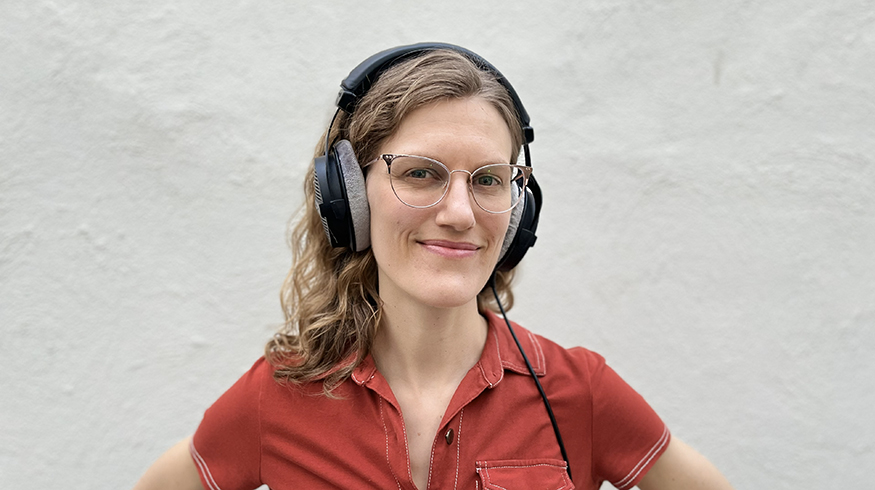
“There are so many paths you can take as an audio engineer,” says UW alum Andrea Roberts. “It never gets old because there’s always something else to learn or expand upon.”
When Beyoncé’s “Cowboy Carter” album won Album of the Year at the 2025 Grammy Awards in Los Angeles, UW School of Music alum Andrea Roberts was in the audience cheering the win. As part of the audio engineering team for the album, it was a win for Roberts as well.
“It’s amazing to be involved in something at that level,” says Roberts, who previously worked on Beyoncé’s “Renaissance” album and film.
Beyoncé’s projects are as high-profile as it gets, but Roberts has worked with recording artists in a wide range of genres, from hip hop to classical, as well as on film projects. “There are so many paths you can take as an audio engineer,” she says. “It never gets old because there’s always something else to learn or expand upon.”
The Intersection of Art and Technology
Roberts earned a bachelor of music in jazz studies in 2010, after studying piano for 15 years. When she started piano lessons as a six-year-old, she could barely tolerate 30 minutes of practice.
“I had a timer and as soon as it went off, I was gone,” she laughs. “But I stuck with it, and around the time I was 13 or 14, it shifted. My parents would have to tell me to stop practicing.”
Roberts has played piano since age six and majored in jazz studies at the UW.
At the UW, Roberts immersed herself in jazz studies and performed with various jazz ensembles and also played keyboards for the Undergraduate Theater Society’s musical productions of Hair and the Rocky Horror Show. After graduating, she spent several years performing in Argentina, in bands ranging from tango to rock. Seeking a wider range of career opportunities, in 2012 she enrolled at Argentina’s Cetear Escuela Internacional de Sonido for a certificate in audio engineering. She’d considered majoring in physics at the UW before music won out, so the idea of working at the intersection of art and technology appealed to her.
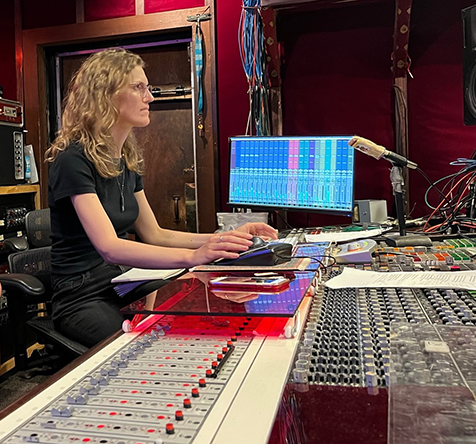
Roberts at the console in a recording studio.
Roberts’ first audio engineering job was at NRG Recording, a commercial recording studio in Los Angeles, where she worked her way up from intern to runner (running errands) to assistant engineer, which involves understanding and setting up all the recording equipment based on the needs of a project.
“A lot of clients will bring in their own engineers, but the studio’s assistant engineer is the one who understands the room and all the gear the studio has,” Roberts explains. “The engineer depends on you because you’re the one who understands how everything in that studio works.”
When Covid hit, the recording studio closed for an extended period, so Roberts pivoted to freelance work. Fortunately, past NRG clients — including members of Beyoncé’s team — remembered Roberts’ skill as an assistant engineer and invited her to work on upcoming projects. Given the paltry representation of women (about 3%) in technical roles on top-charting hits, this was no small feat.
“It was a right place, right time situation,” Roberts says. “Show up and be interested and try to do your best, and people notice that.” Roberts also credits organizations like We Are Moving the Needle and Women’s Audio Mission, which are working to increase opportunities for women and nonbinary audio engineering professionals.
Adding a New Spin to Songs
There is no one job title for Roberts’ work. On some projects, she’s credited as assistant recording engineer; on others she’s mixer or recording engineer or Pro Tools engineer. She’s also worked on film projects as a score mix assistant, technical score engineer, and music editor, all of which involve working with the film score. The variety of job titles hints at the many steps in the audio engineering process, from capturing sound, to blending and editing it, to providing a final polish before a project is shared with the world.
With production and mixing, I can come in and elevate an idea and put a new spin on it, which is really fun for me.
Roberts enjoys all those roles, but her favorites are producing and mixing — the blending and editing of sounds. “When I was playing in bands, I never came up with the idea for a new song, but I would get really excited about helping bandmates flesh out their song ideas,” she says. “If you have a little idea, a little gem of an idea for a melody or rhythm or whatever, then I love taking that and turning it into something. With production and mixing, I can come in and elevate an idea and put a new spin on it, which is really fun for me.”
That’s how a project with UW alum Rocky Duval (BM, Music Ed., 2009) came about. The two Huskies met in high school in Colorado and then, by chance, both studied in the UW School of Music. Duval recently took a deep dive into the music of Saint Hildegard von Bingen, a 12th century abbess and one of only four female doctors of the church. She asked Roberts to collaborate on an album of von Bingen’s compositions, which are among the earliest Western compositions by a woman that exist in written form.
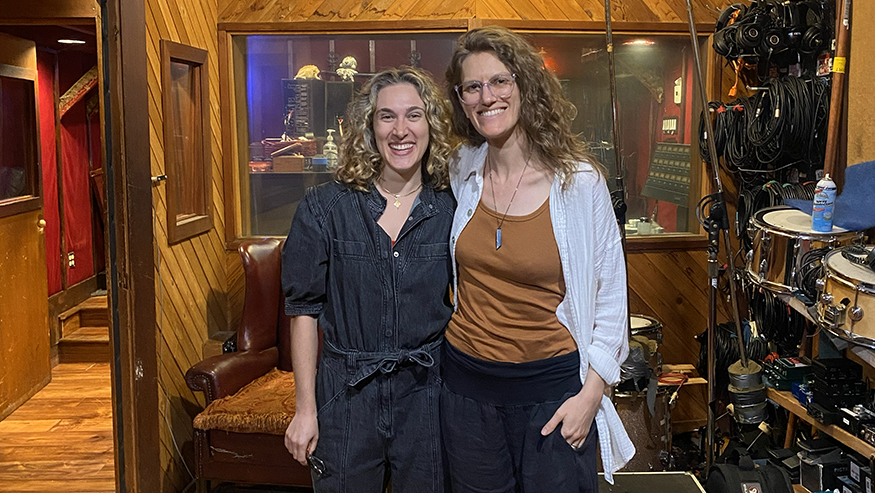
Roberts (right) and UW alum Rocky Duval are collaborating on an album that takes listeners on a journey from very old to very new sounds.
Roberts and Duval collaborated closely to bring Hildegard’s music and Duval’s compositions to life, taking the listener on a journey from very old to very new sounds. The project was an opportunity for Roberts to use her engineering, keyboard, and production skills.
“It’s something I was missing,” she says of the creative artistic collaboration of the album. “That was so much of what I did for so many years, and then as I got more into the engineering, I felt I had to just focus on that to level up career-wise. Now I want to create music with all these tools I have.”
The album, titled MELZITA, will be available February 2026 on select streaming platforms. It may not garner as many Grammy nominations as Beyoncé’s projects, but Roberts is fine with that — though being in Beyoncé’s orbit has definitely been exciting.
“Even more than the Grammys, it’s meaningful to be part of something that is heard by so many people,” she says of Beyoncé’s projects. “It still blows my mind sometimes to think about the reach and scope of something that I had a small piece in creating.”